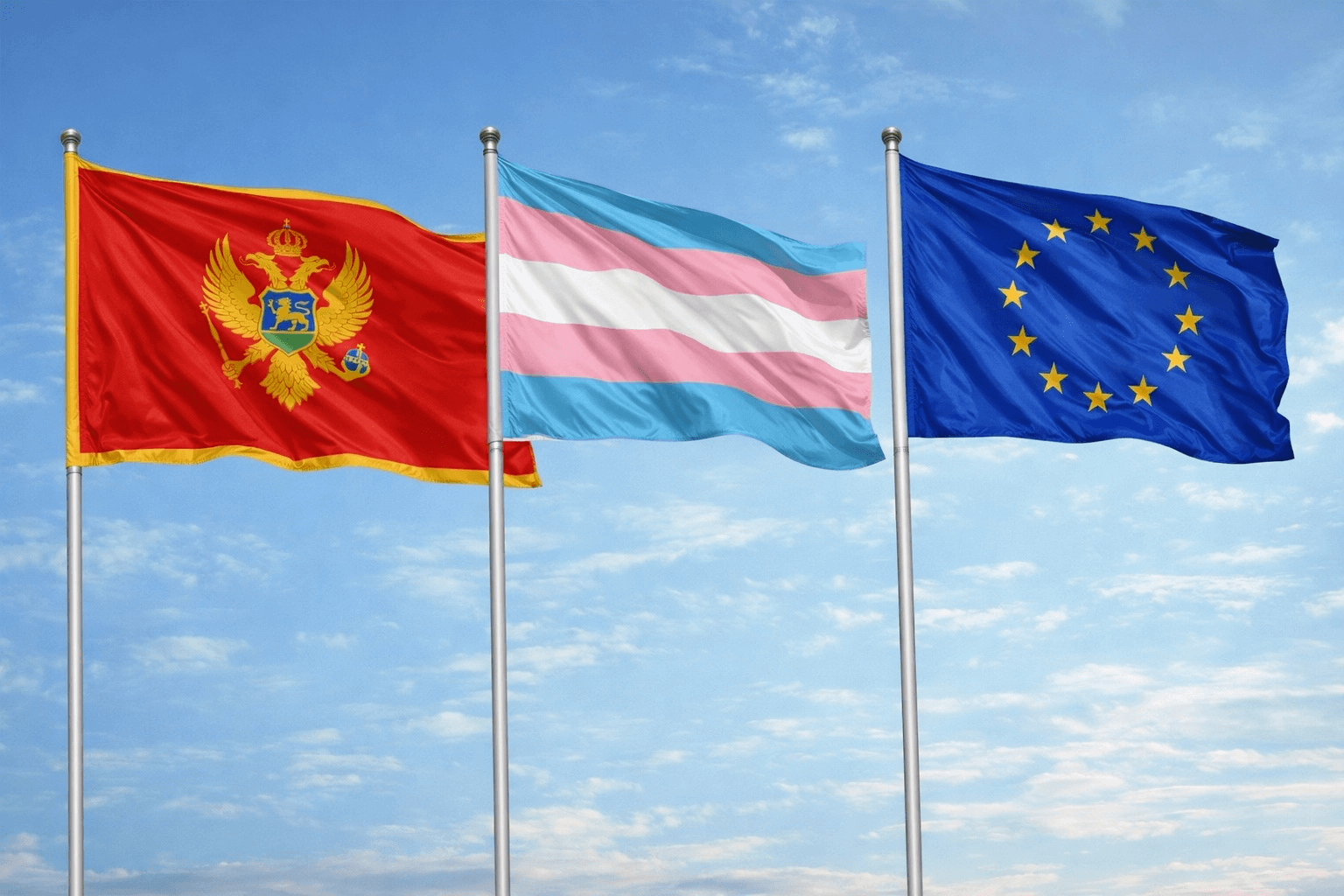
In its this year’s report on Montenegro, the European Commission has once again noted that the Law on Legal Recognition of Gender Identity Based on Self-Determination has not been adopted, and that the Draft of this law has gone through all necessary steps, including consultation with the European Commission. In the section of the report dealing with LGBTIQ+ persons, the Commission also states that discrimination against the LGBTI community still persists.
This report comes at a significant moment as the entire integration process draws to a close, with the closure of remaining chapters expected in a very short period. It must serve as a reminder to the Government of Montenegro that this law is part of the Union’s acquis communautaire, and that without it, closing Chapter 23 will not be possible.
That this law is part of the international legal framework is demonstrated, first of all, by the European Court of Human Rights, which established binding case law back in 2017 (in the case of A.P., Garçon and Nicot v. France), establishing that sterilization and all medical interventions that may lead to sterilization as a prerequisite for changing documents constitute a gross violation of the right to private and family life. The Court of Justice of the European Union (CJEU), which also forms part of the European Union’s legal order, has clearly ruled through its most recent judgments and cases (such as Mirin, Mousse, and Deldits) that the human rights of trans persons form an integral part of the EU legal framework. These judgments require the swift updating of identification documents without the condition of sterilization, introduce mutual recognition of gender changes among member states (the Mirin case), and extend protection against discrimination to changes in gender identity (the Mousse case).
Furthermore, the March 2026 judgment of the Court of Justice of the European Union in the Shipova case (Case C-43/24) expands the case law of this court regarding legal gender recognition. The Court ruled that member state legislation which fails to provide legal gender recognition to citizens who have exercised their right to free movement and residence in another member state is contrary to EU law on free movement. The Court also ruled that “tolerating discrimination based on the difference between biological sex and gender identity would be tantamount, in the case of a transgender person, to a failure to respect the dignity and freedom to which that person is entitled, and which the Court is obliged to protect.” In its argumentation, the Court implied that EU member states must enable legal gender recognition from the very beginning, so that trans persons do not encounter problems right at their first border crossing.
At the same time, a recent judgment of the CJEU (Case C-769/22) against Hungary over its anti-LGBTI propaganda law has also brought about significant progress. The judgment has positive consequences for the protection of LGBTI rights in EU law at the highest level, across all areas, as the Court established for the first time a violation of Article 2 of the Treaty on European Union (TEU), concluding that violations of EU law arose from a horizontal discriminatory approach towards LGBTI persons.
This case law clearly shows that the protection of the rights of transgender persons forms an integral part of the European Union acquis, which Montenegro must respect if it wishes to become the twenty-eighth member state.
As a reminder, the Law on Legal Recognition of Gender Identity was prepared back in 2024, with all necessary endorsements, and has since been waiting for the Government of Montenegro to adopt it and submit it to the Parliament of Montenegro for a vote. While waiting for the Government over the past two years, transgender persons in Montenegro continue to undergo forced sterilization in order to change their gender marker in personal documents, thereby threatening our right to a dignified life, equality, and bodily and personal integrity. We demand that self-determination no longer be delayed, but that the Government take the draft Law out of the drawer and perform its job and the obligations it has committed to.