
The latest annual report of the organization ILGA-Europe on the state of human rights of LGBTI persons in Europe and Central Asia confirms that Montenegro, despite the existing legislative framework, still records serious gaps between formal guarantees and their application in practice. The report points to continuous challenges in the area of protection against violence and hate speech, insufficiently efficient mechanisms of institutional protection, as well as the absence of a law that would enable legal recognition of gender identity based on self-determination.
Although Montenegro has an anti-discrimination framework that includes sexual orientation and gender identity, the report notes that implementation remains inconsistent, and the institutional response to violence and discrimination is often inadequate. Of particular concern is the fact that trans people still do not have the possibility to legally harmonize their gender identity without medical and other retrograde conditions, which makes it impossible for them to be fully adequately recognized within the legal system, and puts them in a state of constant institutional uncertainty.
The report also summarizes the key findings of the institutions of the European Union. In June, the European Parliament, in its periodic report on Montenegro, pointed out the fact that the Draft Law on Legal Recognition of Gender Identity was not adopted during 2024, despite the fact that its adoption is foreseen in the EU Accession Program. In November, the European Commission stated that, despite some progress, Montenegro still has unfulfilled obligations in the key negotiation chapters 23 and 24, and that the Law on legal recognition of gender identity based on self-determination has not yet been adopted, even though previous legislative procedures and consultations have been completed. At the same time, the Law on Prohibition of Discrimination and the Law on Life Partnership of Persons of the Same Sex remain without full implementation, with delays that in some segments last longer than five years.
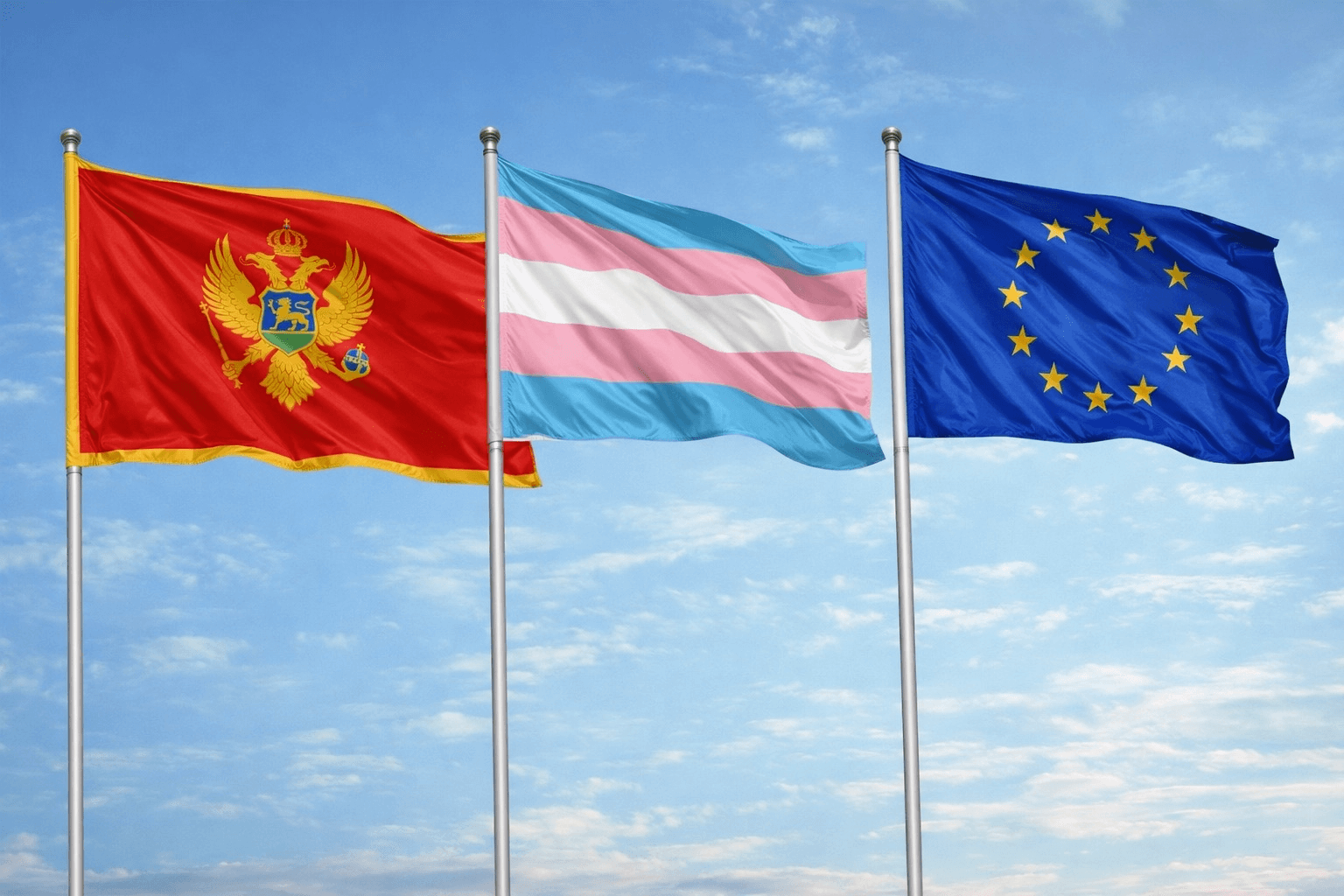
We also note that within the framework of Montenegro’s Accession Program to the European Union, the adoption of the Law on legal recognition of gender identity based on self-determination is a clearly defined obligation within Chapter 23. The upcoming deadline for the adoption of this law is therefore a test of political responsibility, as well as the last opportunity for the Government and competent institutions to eliminate one of the key inconsistencies that international reports have been pointing to for years.
At a time when attacks on human rights and attempts to systematically undermine them are intensifying across Europe, this issue goes beyond technical alignment with EU standards, and represents a clear political commitment: will Montenegro stand by its citizens and guarantee them equal dignity and legal security, or will it continue to postpone obligations and thus show that it understands the European path as a mere form, not as a value obligation.